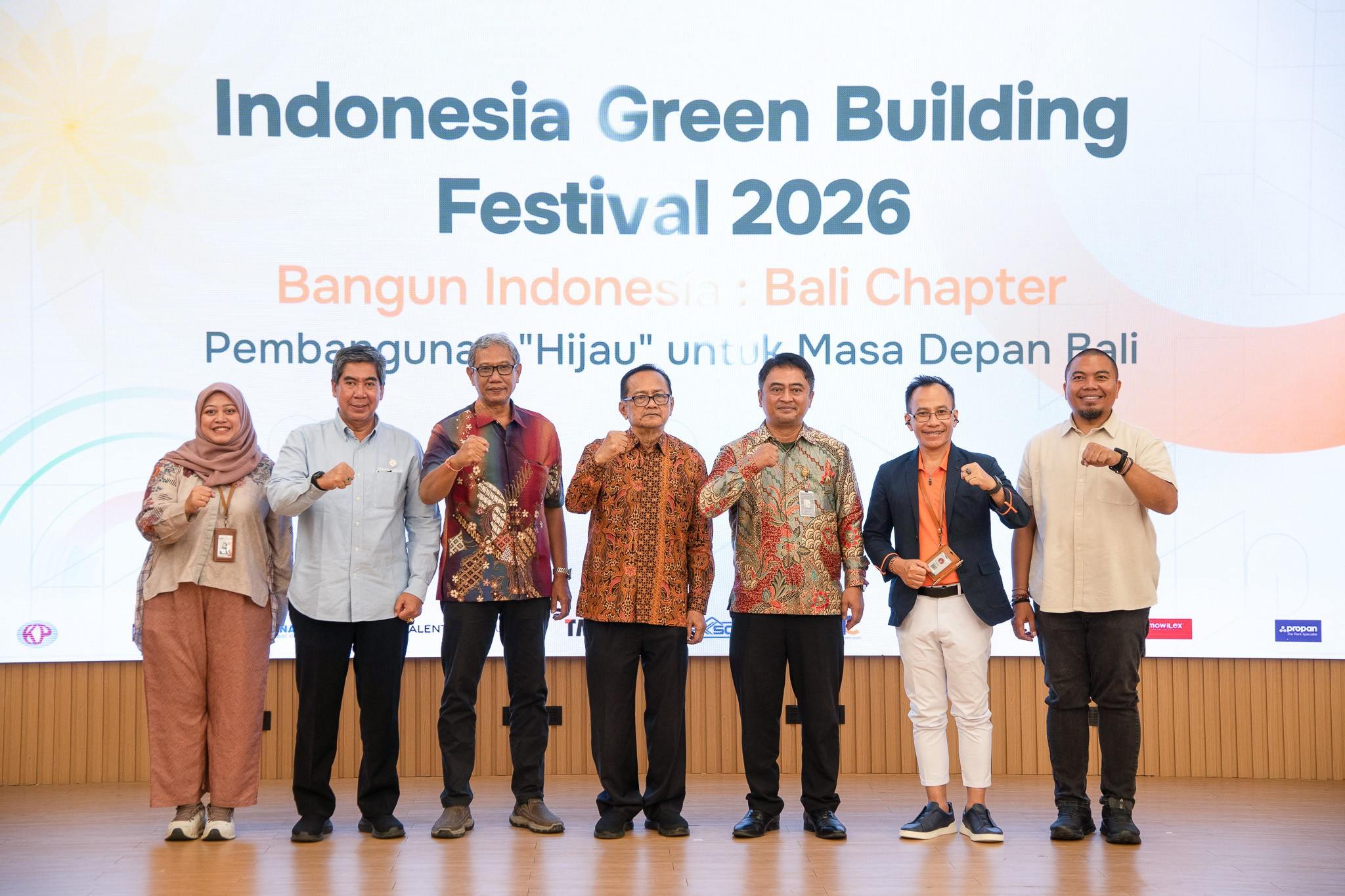
Denpasar, 26 September 2026 — Bali’s identity and development are closely connected to its environment, culture, and growing tourism and economic activities. As development needs continue to increase, the challenge for Bali extends beyond providing infrastructure and buildings that support economic growth. It also involves ensuring that development remains aligned with environmental capacity and the region’s broader sustainability objectives.
Green development is increasingly relevant in this context. Advancing a more sustainable built environment requires an integrated approach encompassing policy, spatial planning, energy efficiency, material use, and urban ecological quality. At the same time, the transition toward low-carbon development requires industry readiness and stronger collaboration among government, academia, professional associations, businesses, and communities.
Responding to these needs, Green Building Council Indonesia (GBCI), through the Indonesia Green Building Festival (IGBF) 2026, presented “Bangun Indonesia: Bali Chapter” in collaboration with GBCI Bali on Saturday, 26 September 2026, at the Auditorium of Universitas Warmadewa. Under the theme “Green Development for Bali’s Future,” the event provided a platform for diverse perspectives on Bali’s sustainable development trajectory while strengthening collaboration across the region’s green building ecosystem.
Ir. Ignesjz Kemalawarta, MBA., GP., Chairperson of GBCI, emphasized that advancing green development requires stronger connections across sectors and stakeholders. The application of green building principles extends beyond individual buildings and needs to be considered within the broader context of districts, cities, ecosystems, and long-term development strategies.
“Bali has a strong identity shaped by the relationship between people, space, and the environment. Green development in Bali therefore needs to consider buildings as part of a broader ecosystem. Policy, design, energy, materials, technology, and human behavior need to move in the same direction to ensure that development delivers long-term benefits for both communities and the environment,” said Ignesjz.
Strengthening Collaboration for Green Development in Bali
Bangun Indonesia: Bali Chapter was officially opened by I Gusti Ngurah Satria Perwira, S.E., M.M., Ak., CSFA., Head of the Audit Board of the Republic of Indonesia (BPK RI) Bali Representative Office and Chair of the GBCI Bali Advisory Board.
The event also featured remarks from Prof. Dr. Ir. I Nengah Sinarta, S.T., M.T., IPM., ASEAN Eng., Dean of the Faculty of Engineering, Universitas Warmadewa; Ir. Ar. Ari Setiya Wibawa, S.T., M.M., IAI., GP., IPM., ASEAN Eng., Chairperson of GBCI Bali; and Gatot Mardiana, President Director of PT Semen Gresik.
Beyond serving as a forum for knowledge exchange, the Bali Chapter highlighted the importance of collaboration in advancing Bali’s green development agenda. This included the Green City Movement recognition across Bali, involving the Public Works and Spatial Planning Offices from across the province, as well as the signing of Memoranda of Understanding (MoUs) with several professional associations and universities.
These initiatives reflect the importance of building stronger institutional networks to support green development at the regional level, connecting government, academia, professional communities, and industry.
Connecting Policy, Energy Transition, and Urban Ecology
The Bali Chapter explored several key dimensions of Bali’s transition toward low-carbon development.
The first talkshow, titled “Connecting Vision, Philosophy, Regulation, and the Energy Transition Toward Bali Net Zero Emission,” featured A. A. Gede Kharisma Krisna, S.T., M.T. The session examined the relationship between Bali’s development vision, policy direction, local philosophy, regulatory frameworks, and the energy transition required to support the region’s Net Zero Emission ambition.
The relationship between buildings and the urban environment was further explored through “GREENSHIP and Urban Ecology,” presented by Ar. Ariko Andikabina, M.Ars., IAI., GP., Director of Rating Development, Digitalization, and Training, GBCI.
The session highlighted the importance of understanding building performance within its wider urban context. Buildings are part of interconnected urban ecosystems, meaning that their environmental performance needs to be considered alongside the conditions and characteristics of their surrounding areas.
From an industry perspective, Arief Sutanto, Product Advocacy Specialist, Brand & Product Management, PT Semen Indonesia (Persero) Tbk (SIG), shared insights into material and industry readiness in supporting the transition toward lower-carbon development.
The program was also complemented by a Green Product Knowledge session featuring Samsung, PT Daikin Airconditioning Indonesia, and Saint-Gobain Indonesia. The participation of these industry stakeholders provided an overview of emerging products and solutions that can support the application of sustainability principles across buildings and the wider built environment.
Sharing Knowledge Across Regions
The second talkshow featured Dr. Ir. DK Halim, M.M., Ph.D., GP., Deputy of Domestic and International Affairs, GBCI, and Ar. Daud Tjondrorahardja, MBA., D. Div., IAI., GP., Chairperson of GBCI Yogyakarta, broadening the discussion through perspectives on green development and experiences from different regions.
For GBCI, knowledge and experience exchange across regions is an important part of strengthening Indonesia’s green building ecosystem. Each region has its own characteristics, challenges, resources, and development priorities. Green development therefore requires collaborative platforms where stakeholders can learn from one another while translating sustainability principles into approaches that respond to local contexts.
The Indonesia Green Building Festival 2026 continues to serve as a platform for expanding knowledge, connecting stakeholders, and encouraging practical action for a more sustainable built environment. Through the spirit of “Bangun Indonesia,” GBCI invites professionals, academics, industry stakeholders, government institutions, communities, young people, and the wider public to contribute to a more sustainable future for Indonesia.